
You need to understand something about policies.
Not government policies. I mean the fine-print, we-are-just-following-rules, nothing-personal policies that companies hide behind while they squeeze the life out of you.
I learned this lesson on a cold day when my car insurance was canceled.
Not because I was a bad driver. Not because I had an accident. Because I was poor. There wasn’t enough money in my bank account to cover the monthly payment. That’s all.
The broker called to tell me. I begged. I pleaded. “Take it from another account. Just give me this month.”
No. Policy.
To get new insurance, I would have to pay a full year upfront. Two thousand dollars. Impossible.
So I drove without it. The daily tasks of life don’t stop. Groceries don’t wait. Kids don’t pause.
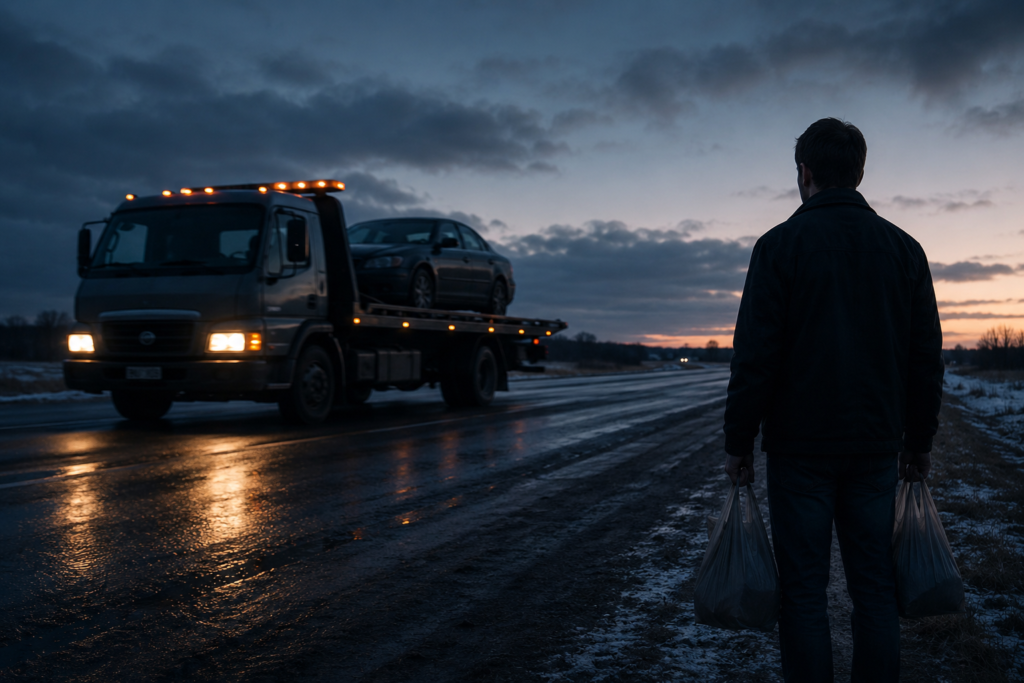
And of course, I was caught. The officer was dutiful. A faithful servant of the system. He gave me three tickets, took my license plate, and left me standing on the roadside with my neighbor Rad.
That was 10:00 in the morning.
The Hostage Situation
What happened next was not a natural disaster. It was not an accident. It was a deliberate, predictable outcome of policies designed by people who will never have to live under them.
I called my CAA membership for a tow truck. The first agent refused because my car had no license plate. Policy. The second agent refused for the same reason. I pleaded for over an hour before I found one agent with a heart.
She agreed to send a truck.
Three hours later, the driver arrived. He was rough. He was cold. And he refused to take my neighbor Rad as a passenger. Policy. Only the vehicle owner. One seat empty. Rad left standing on the side of the road.
Rad had mental health challenges. He panicked. We argued. He called his own towing company. They refused too. Same policy.
This went on for twelve hours.
Twelve hours. Trapped outside. Surviving only on water. Not because of a storm. Not because of a breakdown. Because of a policy.
I watched Rad unload his groceries onto the roadside. I tried to give him money for an Uber. He refused. Anger. Embarrassment. The poison of poverty.
When the tow truck finally pulled away, I looked out the window to wave at him. He was looking the other way.
Two tears rolled down my face.
The driver saw them. His rough demeanor didn’t change. I asked him, “Who benefits from leaving that man on the roadside? You? Me? Your company?”
He was silent. Then: “Company policy.”
I asked why the company makes such a policy. He said the agent on the phone had heard Rad yelling in the background. The agent warned the driver not to pick up someone with an “aggressive temper.”
But Rad wasn’t yelling at the agent. He was arguing with me. And I wasn’t yelling at the agent either. I was just a desperate man pleading for help.
It didn’t matter. The policy had spoken.
The Fine
Three months later, my lawyer—an angel in human form—got the fine reduced. From twelve thousand dollars to three thousand one hundred.
Still crushing. Still more than I had. But less than destruction.
The court’s reason? The fine was almost the same amount as the insurance I couldn’t afford to buy.
So let me be clear: I was fined by my own elected government for the crime of poverty.
Not theft. Not violence. Not fraud. Poverty.
And here is what I need you to understand: this was not the work of evil people. The police officer was doing his job. The tow truck driver was following orders. The insurance broker was reading from a script.
They are all cogs in a machine. The machine is the problem.
The machine is designed to extract. To punish. To leave people standing on the roadside while an empty seat sits beside them.
The Alternative
In the Essentials Economy, we do not have “company policy” as an excuse to abandon each other.
We have the Prime Directive: grow the system until every member’s basic needs are met.
We have the Member Support Protocol: when a member loses income, eviction is paused. Rent is adjusted. A recovery plan is made.
We have the Federation Protocol: no one is left behind because one local fund is empty. The circle is wider than one town.
And we have a simple, radical idea: a person is not a policy. A person is a person.
I wrote this story in Chapter 1 of The Essentials Economy. Not to make you sad. To make you angry enough to build something different.
The tow truck that held us hostage is still out there. But now, so is the blueprint for the road that leaves it behind.