
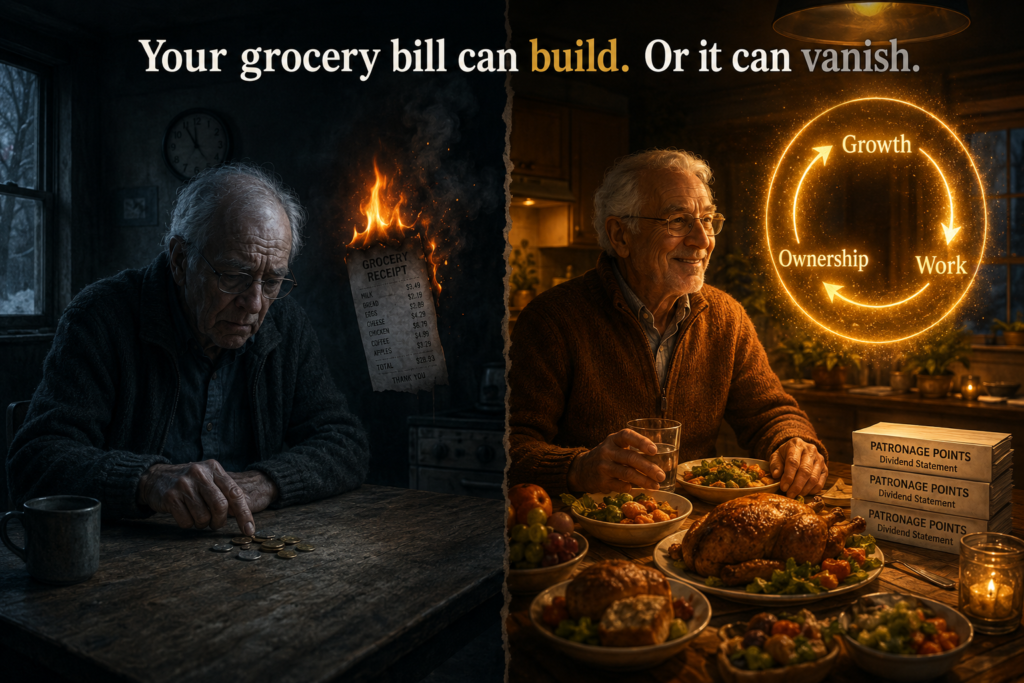
You have been told a lie your entire life.
The lie is this: you must save for retirement. You must put money away every month into an account that grows slowly, if you are lucky, and hope that when you are old, there is enough left to survive.
Meanwhile, your grocery bill eats your paycheck. Your rent eats your paycheck. Your utilities, your internet, your phone—all of it eats your paycheck. And none of it comes back.
You are told this is normal.
It is not normal. It is a design.
The Exit Fee Economy
Every time you buy food, your money leaves. Forever. It pays for the CEO’s bonus, the shareholder’s dividend, the Super Bowl ad. You get a week of meals. They get a lifetime of wealth.
This is not a bug. It is a feature.
The current economy is built on extraction. It is designed to pull value out of your pocket and send it upward, where it accumulates in accounts you will never see.
And then, when you are old and tired, you are told to live on the crumbs you managed to hide from the machine.
But what if the machine worked differently?
The Circulation Economy
What if every dollar you spent on food bought you a share of the store that sold it?
What if the profit from your weekly grocery run was divided into three streams:
- One third grows the system. It builds more stores. More farms. More housing. More of what you need.
- One third rewards the workers. The cashier, the baker, the delivery driver. They are not your enemy. They are your neighbors.
- One third returns to you. Not as charity. Not as a discount. As your rightful share of the wealth you helped create.
This is not a fantasy. This is the Triple-Stream Rule. It is the engine of the Essentials Economy.
And here is the radical part: this third stream does not disappear when you stop working. It grows. Every purchase, every month, every year, your points accumulate. They do not expire. They do not get eaten by fees. They just sit there, quietly building, until the day you need them.
Your grocery bill becomes your retirement fund.
Not because you saved. Because you participated.
How It Works (In Plain Numbers)
Let me give you an example.
You spend 150aweekongroceries.Thatis600 a month. $7,200 a year.
In the old economy, that $7,200 vanishes. Gone. You will never see it again.
In the Essentials Economy, that 7,200flowsthroughamember−ownedcooperative.Thestoremakesamodestprofit—say,10720.
That $720 is split three ways:
- $240 grows the system. It might help open a new store in a neighboring town.
- $240 goes to the workers as a profit-share bonus.
- $240 goes into the Citizen’s Dividend Fund.
Now, you are not the only member. There are hundreds of you. The Dividend Fund grows. At the end of the year, the total is divided among all members based on their Patronage Points.
If you earned 24 points that year (2 per month), and each point is worth 10,yourdividendis240.
That is not nothing. That is a week of free groceries. Or a month of internet. Or a small but real step toward security.
And it grows. Every year. Forever.
The 2-Point Monthly Cap
You might be thinking: what if I am rich? What if I spend $1,000 a week? Do I get more points?
No. You get the same as everyone else. Maximum 2 points per month.
This is the most important rule in the system.
We do not let wealth buy power. We do not let spending dominate ownership. Every member, regardless of income, earns at the same rate. The person who buys one loaf of bread has the same voting power as the person who buys the whole store.
This is how we keep the system democratic. This is how we prevent the accumulation that destroyed the old economy.
You can spend more. You can be generous. But you cannot dominate.
Your extra dollars still help—they flow into the Backup Fund for emergencies and seed capital—but they do not earn you extra stars. Because stars are not currency. Stars are proof of participation. And participation is equal.
The Covenant
I wrote a book about this. The Essentials Economy: A Field Manual for the Parallel Commonwealth. It is the full blueprint—every rule, every table, every spreadsheet.
And here is the radical part: you can download it for free. No email. No gate. Just the blueprint.
Because the idea must be free. The book is just the tool. If the tool helps you build something real, then maybe you buy a copy to seed the Global Universal Capital Fund. Or maybe you don’t. Either way, the idea is yours now.
Your grocery bill does not have to disappear forever.
It can build your retirement. It can build your community. It can build a new world.
You just have to build the store that makes it possible.