
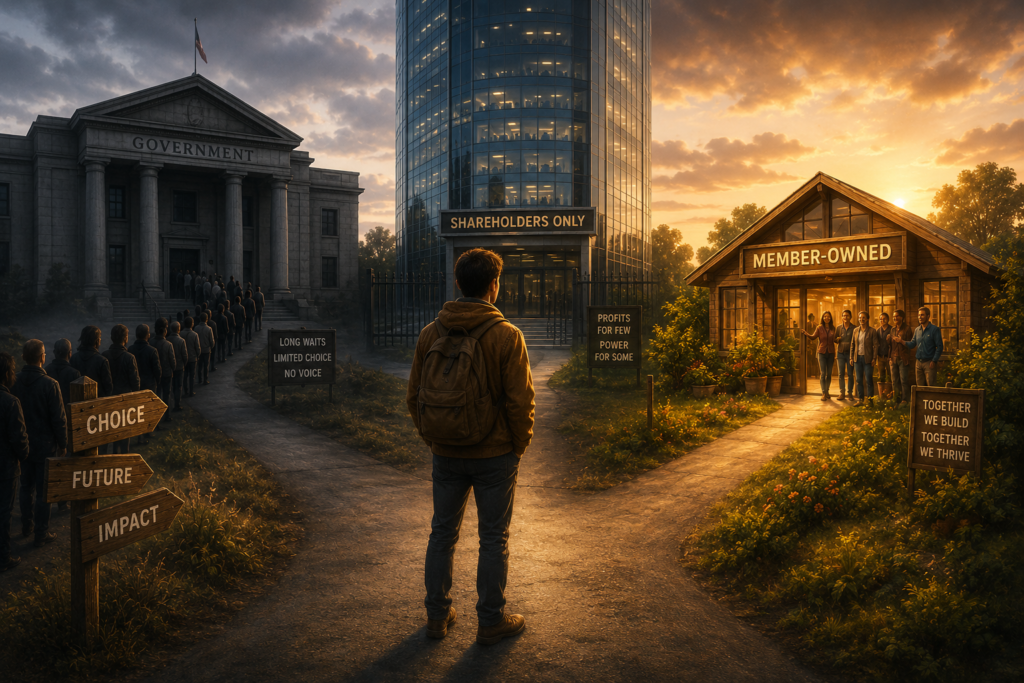
People hear “cooperative economy” and they get nervous. They think of gray buildings. Long lines. The government telling you what to buy and where to live.
That is not what we are building.
Let me be very clear: the Essentials Economy is not socialism.
Socialism, in its traditional form, puts the state in charge. The government owns the factories, the farms, the stores. Bureaucrats decide what is produced, how much it costs, and who gets it.
That system has a long history of failure. It concentrates power in the hands of politicians and civil servants. It creates shortages. It crushes initiative. And it is very, very hard to escape once it takes hold.
We are not doing that.
What We Are Actually Building
The Essentials Economy is a member-owned, market-based, democratic alternative to corporate capitalism.
Here is what that means in practice:
- Member-owned: The people who use the businesses—the shoppers, the diners, the renters—own them. Not the government. Not a board of distant shareholders. You and your neighbors.
- Market-based: We charge competitive prices. We have to be efficient, responsive, and good at what we do. No one is forced to shop with us. We earn your business the old-fashioned way: by being better.
- Democratic: Every member has one vote. Not one vote per share. Not one vote per dollar spent. One person, one vote. The person who buys one loaf of bread has the same say as the person who buys the whole store.
This is not socialism. This is economic democracy—a long and honorable tradition that includes credit unions, mutual insurance companies, and farmer cooperatives.
The Key Difference: Power
In socialism, power flows from the state downward. The government decides.
In capitalism, power flows from wealth upward. The rich decide.
In the Essentials Economy, power flows from participation outward. Every member has a voice. No one has a veto just because they have money. No bureaucrat can shut you down because you didn’t fill out the right form.
You are not a subject. You are not a customer. You are an owner.
Membership Through Consumption, Not Fees
Here is what makes the Essentials Economy different from every other model you have seen.
In a traditional cooperative, you often have to pay a membership fee. You buy a share. You fill out paperwork. There is a barrier to entry.
Not here.
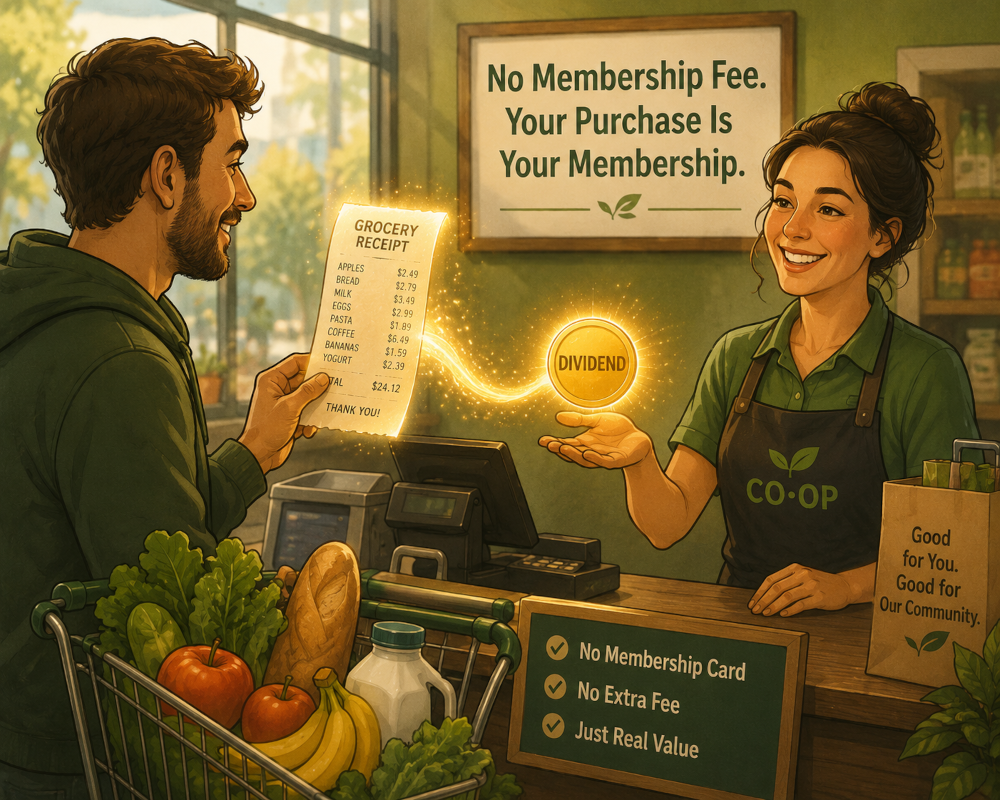
In the Essentials Economy, you become a member simply by buying food.
That is it. You walk into a member-owned grocery store. You buy your weekly vegetables, your bread, your milk. At the checkout, you are automatically a member for that transaction. You earn Patronage Points based on what you spend. No extra fee. No hidden cost. No long-term commitment.
And if you never shop there again? That is fine. You are not on the hook for anything. Membership is not a subscription. It is a consequence of participation.
This matters because most people assume “member” means “pay more.” They think of gym memberships, warehouse clubs, or loyalty programs that charge an annual fee. We do none of that.
Your spending is your membership. Your consumption is your stake.
Where the Profit Goes
At the end of the year, the cooperative adds up all its profits. Then it follows the Triple-Stream Rule:
- One third grows the system (new stores, more farms, better equipment)
- One third goes to the workers (as a profit-share bonus)
- One third goes back to the consumers—the people who bought the food
That last third is not a discount. It is not a coupon. It is a dividend, paid to you based on the points you earned through your purchases. The more you bought during the year, the larger your share.
But here is the key: you never paid a cent for that right. You just bought food you needed anyway.
Your grocery bill did not grow. Your grocery bill built your dividend.
The Simple Test
| Feature | Traditional Co-op | Essentials Economy Co-op |
|---|---|---|
| Do you pay a membership fee? | Often, yes | No. Never. |
| Do you need to fill out paperwork? | Usually | No. Your receipt is your membership. |
| How do you earn points? | By spending | By spending (same) |
| Who gets the profit? | Members (who paid to join) | Consumers (who bought the food) |
This is not a small difference. This is the entire revolution.
We have removed the barrier. You do not need to understand cooperative law. You do not need to save up for a share. You just need to be hungry.
And everyone is hungry.
The Covenant
I wrote a book about this. The Essentials Economy: A Field Manual for the Parallel Commonwealth. It is the full blueprint—including how to start a consumer-owned food service from your own kitchen.
And here is the radical part: you can download it for free. No email. No gate. Just the blueprint.
Because the idea must be free. The book is just the tool. If the tool helps you build something real, then maybe you buy a copy to seed the Global Universal Capital Fund. Or maybe you don’t. Either way, the idea is yours now.
Your grocery bill does not have to vanish. It can build your dividend. It can build your community. It can build a new world.
And you don’t have to pay a cent to join. You just have to eat.
What About Taxes?
We pay taxes. Just like any other business. The difference is where the profit goes—back to the consumers, not to distant shareholders.
What About the Government?
We are not anti-government. We are pro-community.
Governments do essential things. They build roads. They maintain courts. They provide clean water. They protect basic rights.
But governments are not designed to run grocery stores. Or build affordable housing. Or deliver lunch to your office. That work belongs to us—to neighbors, not distant officials; to consumers, not career politicians.
The Essentials Economy does not replace government. It complements it. We handle the things that are too local, too personal, too human for any bureaucracy to get right. And we do it together, without waiting for permission.
You are not a subject. You are not a customer. You are an owner—of your grocery store, your housing, your community’s future.
Governments can help. They can provide seed capital (see Chapter 5). They can pass enabling legislation. But they cannot build the parallel world for us. That work belongs to us.