
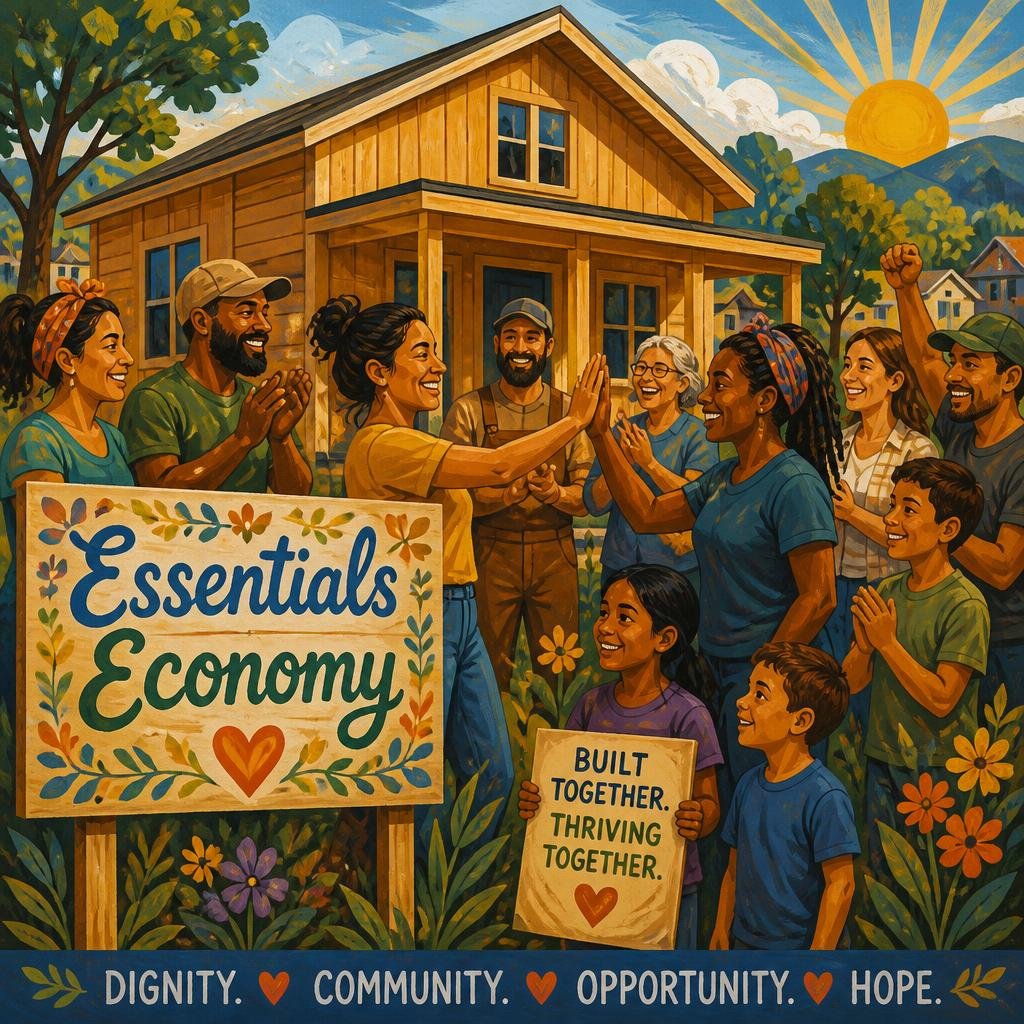
We are told that money is scarce. That governments must choose between helping people and balancing budgets. That we cannot afford bold solutions. But when the housing market wobbles, billions appear. When developers need rescuing, the money is there. When grocery prices soar, governments talk about stepping in—but only to manage the old system, not to replace it.
What if that same taxpayer money—the billions meant for bailouts—was instead used to seed the Essentials Economy? What if we used that capital to build something that would grow, circulate, and never need rescuing again?
Step 1: The Grocery Store on the Corner
I imagined a grocery store on the corner of my street. Not a government-run store. Not a corporate chain. A store owned by the community—seeded by the UCF (Universal Capital Fund), using the capital that would have been a bailout.
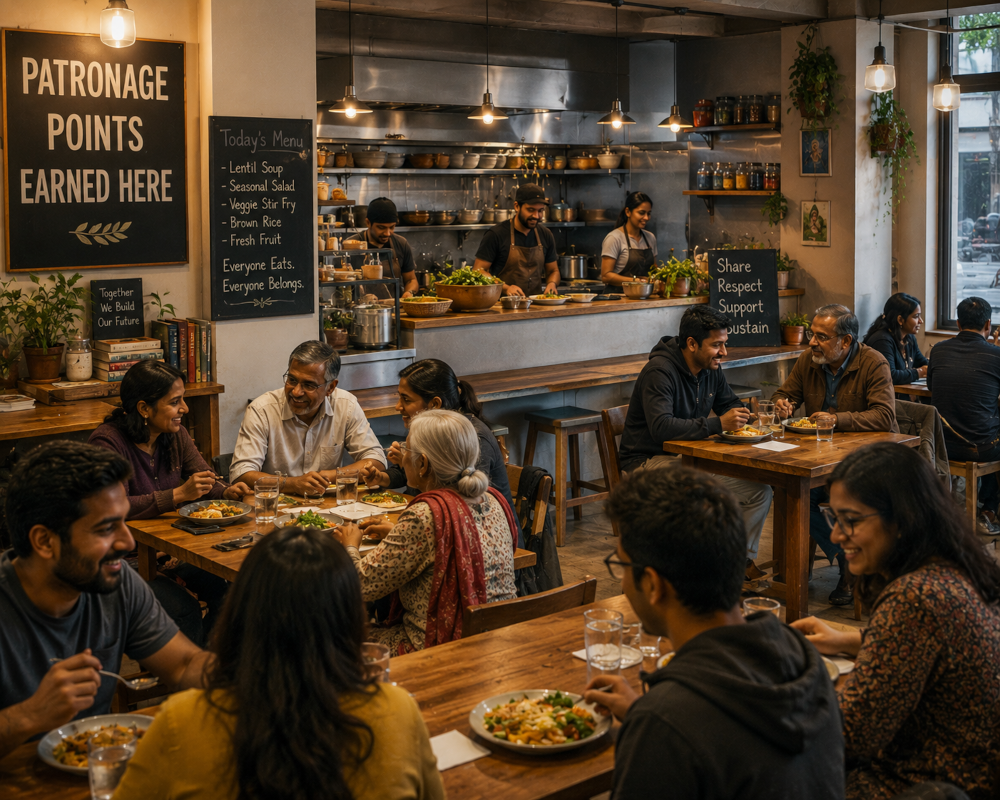
In this store, I can buy my monthly groceries. I spend $150, and I earn Patronage Points—a stake in the store’s profits. Every purchase is not just consumption. It is investment. I am not a customer. I am an owner.
And next to it, a Community Kitchen where I can buy ready-to-eat meals. Maybe I pick them up. Maybe they deliver. Every meal I buy adds value to that $150 monthly spending, helping me collect more Patronage Points.
Step 2: The Supply Chain—Grown Locally
But where does the food come from?
I imagined greenhouses—big, productive, year-round—built by local people using UCF seed money. The workers are Essentials Economy employees and employers. They follow the Triple Stream Rule: profit shared between growth, workers, and the community.
Until the greenhouses are fully operational, the store can still use the old supply chain. No disruption. No chaos. Just a gradual transition to a system that works for everyone.
Step 3: The Best Part—No One Has to Lose
Here is what makes this system beautiful:
The Essentials Economy does not require the old store owner to leave. If the owner wants to stay, they can. They simply sign an agreement with the UCF. The store is appraised. A payout system is designed. The owner continues to run the store—but now under the Triple Stream Rule.
No one is pushed out. Everyone is invited in
Step 4: Imagine the Rest
I didn’t stop at food. I imagined so much more:
| Service | How It Works |
|---|---|
| Transportation | Bus, van, and delivery services owned by the community |
| Landscaping & Snow Removal | Serving every home in the area |
| Car & Machine Repair | Workshops for fixing vehicles and farm equipment |
| Hardware & Home Equipment | Community-owned stores for tools and supplies |
| Carpentry, Plumbing, Electrical | Renovation and repair services under the Triple Stream Rule |
These businesses will not give Patronage Points. Instead, they share their profits with those who earn points through food purchases and monthly contributions to the GUCF and UCF.
Three Patronage Points per person, per month—no more, no less. Fair. Simple. Powerful.
Which Is Fair?
Now ask yourself:
| Bailout Old Economy | Invest in Essentials Economy |
|---|---|
| Money goes to a few developers | Money circulates through the whole community |
| Banks and corporations benefit | Every consumer benefits |
| Money is spent once | Money is seeded and grows forever |
| Government takes on more responsibility | Community takes ownership |
Which is fair? Giving billions to a failing system—or investing in a system that will never need a bailout again?
The Essentials Economy Takes Over
The Essentials Economy does not fight the old system. It offers an alternative. It provides options. It gives the old economy a chance to reimagine itself. And in doing so, it takes over responsibilities that no government can handle alone: food security, housing, transportation, repair services, and community resilience.
We Must Imagine Together
This is not a fantasy. It is a possibility. It is a plan.
But it can only become real if we all imagine it the same way. If we hold the vision together. If we speak it, share it, and build it.
Imagination is how everything in this world becomes real.
Everything you see around you—every building, every business, every system—started as an image in someone’s mind. The old economy was imagined. The new one can be, too.
So I invite you to imagine with me.
Imagine a store on your corner. A kitchen in your neighborhood. Greenhouses in your community. Services that you own. A system that serves you.
Imagine the Essentials Economy.
Then read the book. Share the vision. Join the movement.
#EssentialsEconomy #UCF #GUCF #ConsumerUnity #NewEconomy #HousingCrisis #GroceryPrices #TripleStreamRule #CommunityOwned #BuildDontBail